Showing posts with label lab fun. Show all posts

Tuesday, May 15, 2012

UCLA Science Poster Day 2012!


Today was poster day, and boy did these posters look great! 
The undergraduates in our lab explained their exciting 
new discoveries to the broader UCLA community.

Rachel Stafford-Lewis: 
Proximate mechanisms mediating life history trade-offs in 
facultatively social yellow-bellied marmots


Kathy Nguyen: 
Yellow-bellied marmot call structure is heritable

Lawrance Chung: 
Ontogeny of social partner choice in free-living yellow-bellied marmots
  

Connie Lin: 
Does serotonin modulate social interactions in hermit crabs?

And, last but not least, the "killer" title,
"The Omnivore's dilemma: diet explains variation in roadkill mortality"
By Taylor Cook

There were also members from Barney Schlinger's lab presenting on their research on hormones and genetics in song birds. 


Lots of good questions were asked and new insights were gained...
 
Lawrance's poster provoked a lot of positive (affiliative) 
social interactions within his social group...

 But, alas, all good things must come to an end and the poster's came down. Luckily, the Department of Ecology & Evolutionary Biology will have its own showing of these posters tomorrow, so be sure to stop by the Fifteenth Annual Biology Research Symposium - Wednesday, May 16, 2012, at 1:00 - 4:00PM at the UCLA Faculty Center...See you there!


Tuesday, November 15, 2011

Honors Project in Progress: Mechanisms Mediating Life History Trade-offs

In lab with a complete glucocorticoid sample

My name is Rachel Stafford-Lewis and I am currently involved with an honors research project in Dan Blumstein’s lab here at UCLA. My research project is a two quarter commitment that focuses on analyzing the trade-offs between reproduction and survival in yellow-bellied marmots. My research specifically focuses on glucocorticoid levels, the amount of white blood cells and parasites in the blood samples, and testosterone levels. I hypothesize that the more dominant and higher-ranking male marmots will have elevated testosterone levels, but that maintaining such rank will prove costly and will also result in high levels of glucocorticoid metabolites, white blood cells, and parasites. I hope to discover the correlation between these three factors, or lack thereof, and analyze my results so as to make sense of the compromise between health and fitness.
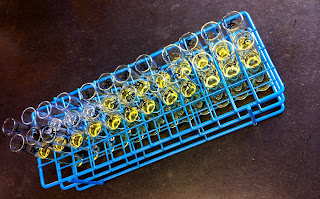
The extraction process-halfway through Day One

I will test my hypothesis using data collected in the field at RMBL in the Rocky Mountains of Colorado. I have spent the last seven weeks utilizing this data by collecting glucocorticoid levels from fecal samples in a precise three day extraction process. As seen in the picture above, the tubes contain a yellowish liquid that is a solution of the hormone, alcohol, and water. This mixture evaporates overnight in the vacuum centrifuge, as pictured in the photo below, so that the end result will only be the reconstituted hormone. The entire procedure involves three strict twenty-four hour sessions where I would repeatedly centrifuge and bathe the samples in a hot water bath, put them in a vacuum centrifuge, vortex, and then place them in the -20 degree freezer. The end result was then pipetted into exact sample sizes, as exemplified in the first picture at the top of the page, and shipped off for analysis.


Extractions at the end of day one in the vacuum centrifuge

Now that the extractions have been completed, the next step is to analyze blood smears for various neutrophils, leukocytes, monocytes, eosinophils, and any obvious parasites. This work is done using a microscope and will be measured by counting the number of white blood cells until we have one hundred total in each one of our samples. This portion of my project is especially important because it is the main indicator of health and will be used for comparisons with the glucocorticoid levels as well as the testosterone levels.

Once the blood smears have been examined I will begin the testosterone assays, which will reveal the relative levels of testosterone in each individual marmot. This will be the final component of my project and hopefully will reveal any connection between dominance and survival in regards to parasite and white blood cell count.

A happy marmot out and about in the Colorado sun

I went into this experience knowing very little about marmots and I have come to appreciate them as adorable creatures and as informative research subjects. I hope that this project will further my knowledge of the relationship between survival and health and how it affects marmot behavior in their natural setting. I look forward to completing my research and finding results that will benefit the extensive research that has already been completed in the Blumstein lab.


Wednesday, December 29, 2010

A Marmot Cake Tradition

One of the great things about working in the lab, besides being surrounded by interesting research in the mountains, was that Dan frequently had potlucks for the marmoteers. A joke between myself (Kathleen) and another marmoteer quickly escalated into reality when I created a marmot cake for a potluck. With the help of my friend Annie, who was an amazing cook in the dining hall, I created a cake that was shaped like a marmot. I’ll be the first to admit that it looked more like a cross between a pig and a bear than a marmot but everyone in the lab enjoyed our creation.


I returned my second summer with a super secret mission, that didn’t involve science but rather baking. I wanted to perfect the marmot cake and I knew exactly what it should be, a rear looking marmot (standing on its hind legs). As I began carving it in the dining hall I ran into my artistic friend Dewey, who helped bring the cake to life. Thus the marmot cake tradition was born. If only Dan knew what was in store for him and the marmoteers when he chose me, an avid creative baker, as his REU student!


Wednesday, December 22, 2010

Merry Marmot Holidays!


This holiday season, Team Marmot gathered round at UCLA to make some holiday treats! I was in the middle of cutting snowflakes out of paper when inspiration hit. Let's make cookies in the shape of marmots.


I am proud to say that my sister is a professional artist, but sadly my skills are not quite up to par these days. Nevertheless, I set-off to make the perfect marmot cookie, biting off the edges of the Christmas star to make a marmot face...


My co-workers were quick to point out the fact that my creation looked a bit more like the face of a badger or even an owl than that of marmot, but you be the judge!


Social facilitation is a strong force in the natural word, and one innovation can often invite others to join in on the fun. Within moments, Julian was on his way to creating a marmot out of a tower of Rice Krispies treats and caramel popcorn.


Finally, a true work of art indeed!


Still others, like Tina and Nicole, went on to create traditional works of beauty out of the tree shaped cookies.


I, of course, decided to carry-on and turned my Christmas Tree cookie into a sleeping marmot splayed out on a warm summer afternoon (or a road kill marmot depending on your vantage point)!

Happy Holidays from Team Marmot!