Saturday, January 14, 2012

Blood evidence used to solve marmot mystery

Hi! My name is Emery Valencia and I'm a research assistant for the Blumstein Lab.

I started out working for this awesome lab as a RA over the summer, conducting observations and trapping the marmots in order to take their measurements. Now that I'm back in the lab, my job is to score blood smears by counting the number and type of white blood cells in individual samples. There are five types of white blood cells: lymphocytes, neutrophils, monocytes, basophils, and eosinophils, with the most common types being lymphocytes and neutrophils. 

Lymphocyte
Neutrophil

Monocyte
             

To view these cells I use a microscope, which is not too different from the scopes I used back in Colorado. As you can imagine, using the microscope for too long can strain your eyes, but eventually you adjust to it and can withstand longer periods of time.

Then...
Now

White blood cells are indicators of an individual's immune system and health. Counting up the these cells allows us to analyze just how healthy the animal was and is therefore an important part of studying physiology and animal behavior, because health can influence an animal's behavior.


On my first day on the job, I found a rather interesting looking organism in one of the slides. I was told the parasites have all but disappeared from our study animals for a while now, but upon observation of this mysterious thing, I had thought that it must have been a parasite.

The suspect surrounded by stained white blood cells...

After talking to one of UCLA's head veterinarians, Dr.Lawson (who generously analyzed the sample for us) reported that it was... nothing but a piece of lint. Although we failed to find a parasite, which is good for the animals, this was a good learning experience.

Anywho, here's another marmoteer update!
Emery

Tuesday, January 3, 2012

Another hard winter?

Winters, for a hibernating marmot, can be hard in several ways.  If they're too long, animals may burn too much fat and starve.  If they're too cold, animals may burn too much fat and freeze.  


This winter, coming after one of the longest and most snowy winters on record, is looking quite interesting in that there is very little snow.  Snow is a blanket, for marmots, and insulates their burrows.  While there is some snow, there's not a lot of snow and that blanket may be a bit on the thin side.  


We'll have to wait for May to find out for sure.

Thursday, December 15, 2011

Eavesdropping ears: mule deer listen to marmot cues

When it comes to Kingdom Animalia, we’re not the only ones that can tap into the conversation!


Our study conducted this summer at the Rocky Mountain Biological Laboratory (RMBL) suggests Mule deer (Odocoileus hemionus) tune into marmot (Marmota flaviventris) alarm calls for hints of nearby predators.

Photo credit: Jenn Smith

Previous scientists noted that mule deer reacted to marmot alarm calls, and we saw this as an opportunity to study interspecific communication in animals of different size, vulnerability and defense mechanisms.

Interspecific communication, or eavesdropping, is when an individual of one species receives and responds to a signal from another species. What’s that information good for, anyhow? Well, if you’re a vulnerable animal foraging, intercepting a pertinent warning can help save your life! Eavesdropping is a useful tactic to learn and can change foraging and antipredator behavior, protection seeking, and group characteristics.


Deer and marmots live in similar areas, and coyotes and potentially mountain lions prey upon both. Therefore, we hypothesized deer would respond to marmot alarm calls versus a common bird song. To test this hypothesis, we conducted a playback experiment.


We recorded mule deer behavior in response to either the song of the mountain white-crowned sparrows (Zonotrichia leucophrys; control), or a marmot alarm call. This was your typical field biology research: wake up before dawn, strap a speaker to your backpack, and head out to track deer, microcassette in hand. Of course, finding deer was usually easier said than done. I quietly recorded the deer behavior 30 seconds prior to and after the sound was played using a prewritten ethogram with typical deer behavior. That information was then analyzed in JWatcher for patterns.

Hiding in veratrum on the search for unsuspecting deer

Turns out for the marmots at RMBL, the marmoteers aren’t the only ones listening in. We found that deer near human settlements had a significantly different response to marmot calls than sparrow songs. Any individuals who heard the call typically became alert and stayed vigilant longer; whereas, those who heard the control were more likely to look and then continue foraging. Deer far from people showed similar responses to marmot calls and sparrow songs probably because they aren’t habituated to a person being around.


Our results are interesting and unique because we have evidence for eavesdropping in animals that are very different in size and vulnerability. These deer have found a potentially reliable source of information through marmots and can use that to either take off into the woods or allocate more time foraging.


There is a lot more work to be done in this field! Future studies can use a remote speaker and camera to study how deer farther away from human settlements react to calls, or how they react to the alarm call of a sympatric species that doesn’t share a predator with them. Perhaps even a study looking at fitness could be useful to know how beneficial eavesdropping is for individuals and populations. The list could go on…


If you’d like to get a more detailed review of this paper, take a look at a copy here.

Thursday, December 8, 2011

Meet Team Marmot: Mega and Lawrance

Hello fellow marmot lovers, field biologists, and any other souls out there. We are among the newest additions to Team Marmot.

My name is Mega Patel (pronounced just like it sounds) and I am a second year Biochemistry major at UCLA. I joined Team Marmot because I love all branches of the sciences, and the Blumstein lab seemed like a great place to expand my knowledge on science outside of chemistry. And my name is Lawrance Chung, a third year Biology major at UCLA. I decided to join Team Marmot because I secretly want to be a marmot. Joke aside, I felt that this lab would be a wonderful opportunity to expand my research experience.

Sorting the poop!

Since September 2011, we have been a part of the Blumstein lab. For the first few weeks we did some of the dirtier work, but we know that the resulting data is worth it. We sorted through fecal samples, from the RMBL group, the tagged wild marmots in Colorado, and the captive group, a control group housed at Colorado State University by Greg Florant from which experimental validations of our assays were carried out. Our work is done directly under the mentorship of Dr. Jennifer Smith (shown below).

Jennifer Smith with a captive marmot at
Colorado State University

The purpose of sorting these fecal samples was to get an accurate measurement on how stressed each particular marmot is on a day-to-day basis. While hair samples can provide an idea of how stressed one was months ago, and blood can be used to measure how stressed a particular individual is within a matter of minutes (reflecting trap stress), fecal samples can actually measure how stressed the marmots were yesterday (before the trapping event), which is exactly the kind of data this lab wants to add to its database.

Greg Florant with a captive marmot at
Colorado State University

Like you might have already guessed, we measure the “stress” level of marmots by measuring the concentration of glucocorticoids in their processed fecal samples. The process begins by sort through the fecal sample to obtain a pure sample. This means removing the different fibers, seeds, and occasionally rocks from the sample after creating a nicely mixed bag of feces that we fondly liked to call poo-dough. Then after a single sample was cleaned,it was carefully weighed to 0.20 grams. The accuracy of the weight was very important and we took great care in measuring the samples as close to 0.20grams each as we could. This precision was necessary so that the resulting concentrations of the glucocorticoids could be compared among different marmots. A larger weight could mean a higher concentration, causing the data to reflect the marmot being more stressed than it actually was. In addition, each marmot sample was carefully labeled with an unique ID to ensure that samples from different marmots were not mixed.


Currently we are sorting through and labeling blood and plasma samples from different marmots dating as far back as 2002 and have been preserved in a -80 ˚C freezer. The sorting process involves going through and individually labeling each vial with a unique ID. This sounds much easier than it is because we have to first be able to match up the vial to the correct entry in our database, which does not always happen as sometimes the dates or time will be off. Then comes the tricky part of trying to write on a frozen vial, however, with the help of Emery and Rachel, we have made great progress and will be done within the first week of next quarter.

It has definitely been a wonderful quarter with Team Marmot and we look forward to the next one! Happy Holidays everyone!

Tuesday, November 29, 2011

Late for work?


Hello world! My name is Lawrance Chung and I have been working at UCLA in Dan Blumstein’s lab for the past quarter. Hopefully most of us don’t find ourselves in this situation too often, but sometimes we are just so tired, that we can’t wake up in the morning. I recently found myself in this position and I was late to lab, but I had a good reason. I saved a life!

As part of the Care Extenders program, I volunteer in the Emergency Room during the night. It just so happened that I was volunteering the night before and an elderly lady needed CPR. Luckily, I happened to be in the right place and at the right time to help her. After around eight minutes, though it felt much longer for me, of CPR we were able to get her heart beating again. It was definitely a successful night.

One thing I didn’t expect was how sore my arms would be afterwards. I was honestly tried. So now, the next time I don’t feel like getting out of bed in the morning, I try to see if I have a better excuse than saving a life, and if I don’t, I get up and head to work.

Tuesday, November 15, 2011

Honors Project in Progress: Mechanisms Mediating Life History Trade-offs

In lab with a complete glucocorticoid sample

My name is Rachel Stafford-Lewis and I am currently involved with an honors research project in Dan Blumstein’s lab here at UCLA. My research project is a two quarter commitment that focuses on analyzing the trade-offs between reproduction and survival in yellow-bellied marmots. My research specifically focuses on glucocorticoid levels, the amount of white blood cells and parasites in the blood samples, and testosterone levels. I hypothesize that the more dominant and higher-ranking male marmots will have elevated testosterone levels, but that maintaining such rank will prove costly and will also result in high levels of glucocorticoid metabolites, white blood cells, and parasites. I hope to discover the correlation between these three factors, or lack thereof, and analyze my results so as to make sense of the compromise between health and fitness.

The extraction process-halfway through Day One

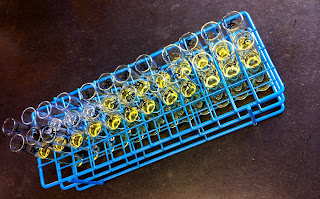
I will test my hypothesis using data collected in the field at RMBL in the Rocky Mountains of Colorado. I have spent the last seven weeks utilizing this data by collecting glucocorticoid levels from fecal samples in a precise three day extraction process. As seen in the picture above, the tubes contain a yellowish liquid that is a solution of the hormone, alcohol, and water. This mixture evaporates overnight in the vacuum centrifuge, as pictured in the photo below, so that the end result will only be the reconstituted hormone. The entire procedure involves three strict twenty-four hour sessions where I would repeatedly centrifuge and bathe the samples in a hot water bath, put them in a vacuum centrifuge, vortex, and then place them in the -20 degree freezer. The end result was then pipetted into exact sample sizes, as exemplified in the first picture at the top of the page, and shipped off for analysis.


Extractions at the end of day one in the vacuum centrifuge

Now that the extractions have been completed, the next step is to analyze blood smears for various neutrophils, leukocytes, monocytes, eosinophils, and any obvious parasites. This work is done using a microscope and will be measured by counting the number of white blood cells until we have one hundred total in each one of our samples. This portion of my project is especially important because it is the main indicator of health and will be used for comparisons with the glucocorticoid levels as well as the testosterone levels.

Once the blood smears have been examined I will begin the testosterone assays, which will reveal the relative levels of testosterone in each individual marmot. This will be the final component of my project and hopefully will reveal any connection between dominance and survival in regards to parasite and white blood cell count.

A happy marmot out and about in the Colorado sun

I went into this experience knowing very little about marmots and I have come to appreciate them as adorable creatures and as informative research subjects. I hope that this project will further my knowledge of the relationship between survival and health and how it affects marmot behavior in their natural setting. I look forward to completing my research and finding results that will benefit the extensive research that has already been completed in the Blumstein lab.


Sunday, November 13, 2011

Good news in the lab...

Several pieces of good news to report have been building up over the past few weeks.

Some key papers have been accepted.

•Carrasco, M.F. and D.T. Blumstein.  2012. Mule deer (Odocoileus hemionus) respond to yellow-bellied marmot (Marmota flaviventris) alarm calls. Ethology.  Malle was an REU fellow last summer and this paper shows that mule deer pay attention to marmot calls.  I think this is really neat because it shows that animals have effects on other species through their vocalizations and the idea of interspecific communication is a topic that needs much more work.
 
•Olson, L.E., Blumstein, D.T., Pollinger, J.P., and R.K. Wayne.  2012.  Beneficial inbreeding:  yellow-bellied marmots do not discriminate against mating with relatives. Molecular Ecology.  This is the final chapter from Lucretia's dissertation that surprisingly shows that male marmots do better NOT trying to avoid inbreeding with close relatives.
•Pollard, K.A., and D.T. Blumstein.  2012.  Evolving communicative complexity:  insights from rodents and beyond.  Philosophical Transactions of the Royal Society.  Kim and I have been continuing our thoughts about how complex communication evolves and this paper stems from a symposium talk that we gave at the animal behavior society meetings this past summer.


•Matt passed his oral qualifying exam.

•We've also (thanks to Jenn's leadership and a lot of work on Rachel's part) just extracted all of our 2011 cort samples and are in the process of sending them off for a radioimmunoassay. 

So, some good news all around.