
Have you ever heard a marmot's alarm call? I have! It's a distinctive, high-pitched, whistle-like sound that could be clear and piercing, or pretty noisy.
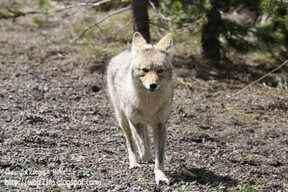
Marmots alarm call when they get scared, be it from predators trying to eat them...

The question is - whether the marmot alarm call, this sound of fear, can be a quantitative measurement of just how scared these marmots are. This is what my past year's research is all about. To read the recently published article on this topic by Dan and me, you may have to purchase access to Biology Letters here. For the short, free version, just read on.
Dan and I hypothesized that marmots would produce clearer alarm calls when they are less scared and noisier calls when they are more scared. We used a measure of noise known as Wiener entropy to quantify the noise within the calls. To quantify fear, we measured the glucocorticoid levels found in marmot fecal samples, with higher glucocorticoids indicating greater fear.
We then extracted seven years' worth of data on marmot alarm calls and their associated fecal samples recorded and collected, respectively, in RMBL. These data were compiled by the marmoteers during the summers of 2003 thru 2009; when the marmots called, they recorded them; when the marmots pooped, they picked up after them, and sometimes quite literally, wiped their butts. (Thanks for all the hard work, guys!)
After repeated analyses controlling for all the variables we could think of, including but definitely not limited to sex, mass, age, background noise, and call harmonics, we got the same surprising result - the marmots are generating clearer, less noisy alarm calls when they are more scared.
A couple days' worth of head-scratching later, Dan and I decided that our surprising result makes sense after all. Positive correlations between heightened stress and clearer calls have also been demonstrated in piglets, dwarf goats, and dogs. Of course, formal experiments will have to be conducted to show a causal relationship between fear and the clarity of alarm calls.
After repeated analyses controlling for all the variables we could think of, including but definitely not limited to sex, mass, age, background noise, and call harmonics, we got the same surprising result - the marmots are generating clearer, less noisy alarm calls when they are more scared.
A couple days' worth of head-scratching later, Dan and I decided that our surprising result makes sense after all. Positive correlations between heightened stress and clearer calls have also been demonstrated in piglets, dwarf goats, and dogs. Of course, formal experiments will have to be conducted to show a causal relationship between fear and the clarity of alarm calls.
In a more intensely fear-induced state, the marmots' vocal folds are pulled more taut, effecting clearer, more piercing calls. The clarity of the call can, in turn, ensure that marmots in the area who hear the call would clearly receive the message. As such, the fear-induced clarity in alarm calls could be selected for within marmot colonies.

Try putting yourself in the situation of a scared marmot. Are your calls likely to be more or less sharp and clear if you experience a heightened state of fear?


