Monday, October 31, 2011

Scared and Less Noisy

Have you ever heard a marmot's alarm call? I have! It's a distinctive, high-pitched, whistle-like sound that could be clear and piercing, or pretty noisy.

Marmots alarm call when they get scared, be it from predators trying to eat them...
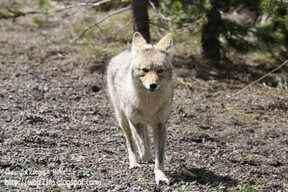


...or from marmoteers trying to bag them (to take their measurements).


The question is - whether the marmot alarm call, this sound of fear, can be a quantitative measurement of just how scared these marmots are. This is what my past year's research is all about. To read the recently published article on this topic by Dan and me, you may have to purchase access to Biology Letters here. For the short, free version, just read on.

Dan and I hypothesized that marmots would produce clearer alarm calls when they are less scared and noisier calls when they are more scared. We used a measure of noise known as Wiener entropy to quantify the noise within the calls. To quantify fear, we measured the glucocorticoid levels found in marmot fecal samples, with higher glucocorticoids indicating greater fear.

We then extracted seven years' worth of data on marmot alarm calls and their associated fecal samples recorded and collected, respectively, in RMBL. These data were compiled by the marmoteers during the summers of 2003 thru 2009; when the marmots called, they recorded them; when the marmots pooped, they picked up after them, and sometimes quite literally, wiped their butts. (Thanks for all the hard work, guys!)

After repeated analyses controlling for all the variables we could think of, including but definitely not limited to sex, mass, age, background noise, and call harmonics, we got the same surprising result - the marmots are generating clearer, less noisy alarm calls when they are more scared.

A couple days' worth
of head-scratching later, Dan and I decided that our surprising result makes sense after all. Positive correlations between heightened stress and clearer calls have also been demonstrated in piglets, dwarf goats, and dogs. Of course, formal experiments will have to be conducted to show a causal relationship between fear and the clarity of alarm calls.

In a more intensely fear-induced state, the marmots' vocal folds are pulled more taut, effecting clearer, more piercing calls. The clarity of the call can, in turn, ensure that marmots in the area who hear the call would clearly receive the message. As such, the fear-induced clarity in alarm calls could be selected for within marmot colonies.


Try putting yourself in the situation of a scared marmot. Are your calls likely to be more or less sharp and clear if you experience a heightened state of fear?

Friday, October 7, 2011

Field Ecology in the Digital Age

In early 2010, Dr. Ian Billick, RMBL Executive Director, was awarded an NSF grant for a project entitled "Bringing a Field Station into the Classroom." Working with Dr. Amy Ellwein, newly hired from the University of New Mexico, the intention was to make online tools and some of the long-term data sets collected at RMBL available to college students through interactive curriculum hosted on a new website. Many of you know this as the "CCLI project" for the NSF program that funded it. A Division of Undergraduate Education (DUE) program, CCLI (Course Curriculum and Laboratory Improvement) has since changed to TUES (Transforming Undergraduate Education in Science) and the project is now known to many of us as "Digital RMBL".


One year and a few months into a three-year project, the team is very close to initial completion of most project deliverables, and are moving into the testing and improvement stage. Thanks to many in the RMBL community - you know who you are - we have moved beyond expectations in several aspects of the project's scope. For example, two of our project collaborators liked the structure of the natural history pages so much, they've assigned the project to their students. We now have ten times more natural history pages than we promised NSF, with more in the works. If you would like to lend a hand, Amy has more ideas than time to pursue them, just send her an email: amy AT rmbl DOT org. And keep your eyes peeled for the web debut of Digital RMBL in November at http://rmbl.org/rockymountainbiolab/!

Thursday, September 8, 2011

Masculinised female yellow-bellied marmots initiate more social interactions

In a paper just published in Biology Letters, former Blumstein Lab postdoctoral fellow, Raquel Monclús, along with undergraduate Taylor Cook and Dan report on the effects of natural variation in testosterone on female behavior.

We know that the fetal environment may generate profound, lifelong effects. We studied the effects of litter-sex ratio on female yellow-bellied marmots. We found that females growing up in male-biased litters, a situation which exposes them to male hormones during development, were more likely to initiate play and allogrooming as pups, but as yearlings were more likely to engage in estrogen-mediated sociopositive behavior. We suspect that this worked by making these “marmot tom-boys” engage in more exploration, a behavior that led to more encounters with others as well as increasing the likelihood of dispersal. Our results further illustrate the diverse consequences that endocrine disruptors might have in wild animals.

The BBC (along with some other news sources) picked up the story.
Read the BBC article here.

Photo from BBC News Story

Monday, August 29, 2011

Marmot outreach makes news

"Marmot Week" highlighted on RMBL webpage:
(click here to see the original story)


Teaching (and Learning) More About Marmots
: RMBL's marmot project is currently in its 50th year. Because of our long track record and and because marmots are such fascinating animals, Team Marmot has many lessons to pass onto the next generation of scientists. Each year, team marmot shares its passion for understanding ecology with young and aspiring naturalists at RMBL's Kids Nature Camp.


Photo by Annie Starr: Jenn Smith quizzing students about the ecology of marmots

This season two marmoteers from the University of California Los Angeles helped students to gain key insights into the secret world of marmots. Jenn Smith (in photo above, quizzes students about marmot ecology) is an American Association of University Women Postdoctoral Fellow and Nicole Munoz is a National Science Foundation Predoctoral Fellow.

They first demonstrated the techniques used to observe and live-trap marmots. Then, Jenn and Nicole explained how they perform manipulative experiments to understand how marmots cope with their social worlds and natural threats. For example, students learned how researchers assess whether or not marmots are capable of distinguishing among the different cues of predators.


Photo by Annie Starr: Students distinguishing between the scents of coyote and deer urine

One highlight from this training exercise occurred when students were asked to distinguish among the predators producing various vocalizations and scents (see above). Students were amazingly astute at distinguishing between coyote and deer urine. After marmot week at RMBL, these inquisitive students are now armed with new knowledge of and enthusiasm for understanding the natural world.


Friday, August 26, 2011

Little man: back by popular demand

Thanks for all of your fun inquires about little man!

Photo by Jenn Smith


For those of you wondering how he is doing in face of predation and with all of his female admirers, the outlook is indeed very good. Little man (below on right) continues to fatten-up for the winter and attract the attention of the females marmots (e.g., "F" on left below).

Photo by Jenn Smith


In fact, as some of you wondered, there are evolutionary trade-offs for fat marmots. Marmots must be fat to withstand months of hibernation, but very fat marmots with slow escape speeds are vulnerable to predation. To understand such trade-offs we continue to live trap and observe all of our marmots.

In fact, after we live trap a marmot from our population, we scurry behind him or her to record the maximum speed at which a marmot is able to run away from a potential threat.


Photo by Jenn Smith

We look a bit silly in the field chasing marmots and even the ground squirrels notice take notice of our odd behavior. As obligate hibernators, ground squirrels also seem to be getting quite chubby these days. This is great for them though because winter will be upon us soon enough!

Monday, August 22, 2011

"Little" man?

Our field season is nearing to an end which means that marmots are putting on body fat in preparation for hibernation.

Photo by Jenn Smith

Above and below are recent photos of the marmot with the mark, "little man." Judging by the size of his stomach relative to his front legs, we need have to consider renaming this marmot "pudgy little guy".

Photo by Jenn Smith

The ladies sure seem to like him though; he currently defends the largest harem of females out of all of our colony sites!

Thursday, August 11, 2011

Marmot Blog: Tales of a Marmot Hunter


Check out the following story at, "Tales of a Marmot Hunter," another blog written by a marmot enthusiast also living in Colorado. Although some folks do still hunt marmots, the of this blog, , is simply out hunting for the rush of observing the adventures of marmots, so check it out!

For example, a recent post said, "As we were about to leave, I spotted a rather good looking marmot making his way around the lake, no doubt returning home from a visit with his lady friend. He came all the way around the lake to the outlet, where Icy Brook was racing along.

IMG_1635a by typebangin

He was going to cross the creek!!

IMG_1637a by typebangin

Sizing things up, he hopped from rock to rock with amazing dexterity!!

IMG_1638a by typebangin

Marmots may look like lazy fatties, but they can really move when they have to.

IMG_1640a by typebangin

As he made his way across, it became clear that he was heading straight towards us.

IMG_1643a by typebangin

He darted behind a rock, and then all of a sudden, we were standing face to face.

IMG_1647a by typebangin

We exchanged knowing glances, and then as quickly as he appeared, he was gone."


IMG_1648a by typebangin